
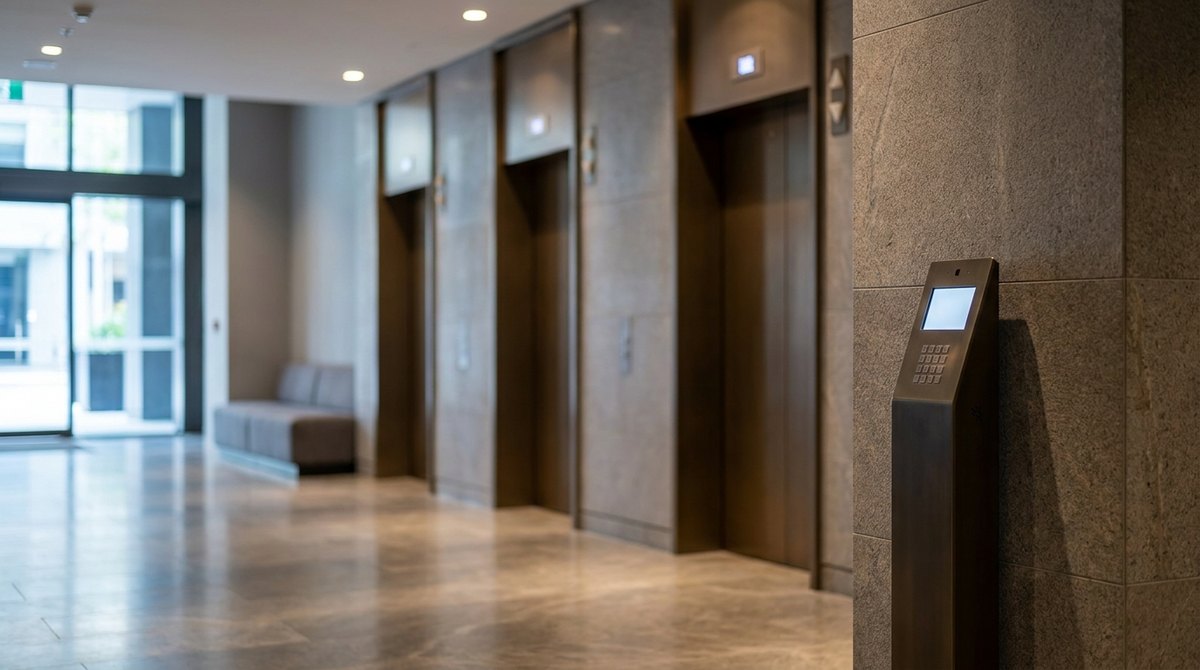
In a building with destination control, the passenger chooses before the lift arrives rather than after. Almost everything tenants notice about the system follows from that one change.
Conventional collective control and destination control differ in where the passenger states their destination. Under conventional control, a passenger presses up or down at the landing and selects a floor from the panel inside the car. Under destination control, the passenger enters the destination floor at a terminal in the lobby and the system responds with the car to board, with no floor selection inside. Because the system knows every destination before the doors open, it can group passengers travelling to the same floors into the same car, which cuts the stops each trip makes. The trade tenants feel is that time spent travelling falls while time spent waiting at the lobby can rise.
How does destination control actually work?
Under conventional collective control, a landing call carries one piece of information: a direction. The control system knows somebody on level six wants to go up, and nothing more. It answers calls in the direction a car is already travelling, and only learns where each passenger is going once they have boarded and pressed.
Destination control inverts that. The call carries the destination itself, entered at a lobby terminal or registered automatically from an access credential. The system allocates a car at the moment the call is made, against the current position, direction and loading of every car in the group, and tells the passenger which one to board. Inside the car there is usually no floor selection — the panel reduces to door controls, an alarm and, on some systems, a means of re-registering.
The consequence is that the group is dispatched on known demand rather than inferred demand. Passengers with common destinations are pooled, so each trip serves more people in fewer stops.
What changes for tenants?
The decision moves to the lobby. Passengers commit before boarding, and changing their mind mid-journey is no longer a matter of pressing another button. Regular occupants absorb this within days. Visitors meet it at the moment they are already least certain where they are going.
Journeys shorten; waits can lengthen. Fewer stops per trip means less time in the car. But allocation may hold a passenger for the car that serves their floor efficiently rather than the first one available, so waiting time and transit time move in opposite directions. A system reported as faster on total journey time can still be experienced as slower in the lobby, which is where people form their opinion of it.
The lobby becomes part of the lift system. Terminals have to sit where arriving people meet them without doubling back, with room to queue clear of the entry doors. Passengers then walk to an assigned car rather than the nearest one, so sightlines, car designations and signage do work that a conventional lobby never asks of them.
The constraint can move. At peak, a group with ample car capacity can still bottleneck at the terminals. How many entry points there are, and where, matters alongside how many lifts there are.
Accessibility has to be designed in. A passenger who cannot see the assignment display, reach a terminal, or read it before it clears must still be able to travel independently. Audible and tactile assignment and a route for assisted travel are design requirements, not refinements.
Access control integrates more naturally. Where a building is zoned by floor, a credential can register a destination and enforce the zoning in the same action — the pass becomes the call. For multi-tenant buildings this is often as strong a driver as traffic performance.
Unfamiliar users carry a cost. Buildings with heavy transient traffic pay the learning cost on every new arrival. Concierge presence, terminal design and signage absorb it, or the tenants do.
Bulk movement needs a defined mode. Moving a large group, a delivery or a fit-out load through a destination system should be a provided function rather than something worked around on the day.
Where does each approach win?
| Situation | Conventional collective | Destination control |
|---|---|---|
| Low-rise, few floors served | Simple, familiar and entirely adequate | Little traffic to pool, so the gain is small |
| Tall buildings, many floors, stop-bound demand | Stops accumulate through the trip | Where the grouping gain is largest |
| Heavy interfloor traffic through the day | Calls answered by direction only | Known destinations let allocation pool trips |
| Multi-tenant with floor-level security | Access control added to the car panel | Credential registers the destination and enforces zoning |
| Many unfamiliar or transient users | Nothing to learn | Learning cost on every arrival; needs support |
| Constrained or shallow lobby | No terminals to place | Terminal placement and queue space become design constraints |
What destination control does not fix
Dispatch is not capacity. If a group is undersized for its demand, cleverer allocation redistributes the shortfall rather than removing it — a building short of a lift is short of a lift. The number of lifts a building needs is settled by the traffic study, not by the control strategy layered over it.
Nor does it compensate for equipment that is not running. Allocation works with the cars in the pool, and a unit out of service is not in it, so a group with a persistent availability problem will disappoint under either strategy.
The benefit also depends on there being something to pool. A building whose traffic is thin and evenly spread across the day gives the algorithm little to work with, and the case for it weakens accordingly.
What to ask for at design stage
- Both strategies simulated against the same demand, using the profiles that matter for the building's actual use — morning arrival, the lunch peak, and any shift or event pattern particular to the building.
- Waiting time and transit time reported separately. A single journey-time figure conceals precisely the trade tenants notice.
- The lobby designed with the system, not around it: terminal count and position, queue space, and sightlines to the assigned cars.
- Accessible travel demonstrated rather than asserted, including how a passenger who cannot use a terminal unaided completes a journey.
- Behaviour under degraded conditions — a car out of service, a terminal out of service, and the emergency and fire modes applying to the building.
- A stated basis for the results. Grading against PCA, CIBSE Guide D and ISO 8100-32 makes the comparison auditable rather than a matter of assertion.
Short FAQ
Can destination control be retrofitted to existing lifts? Often, where the control system supports it — but group control is shared across the units it dispatches, so it is seldom a change that can be made to one lift alone. It usually arrives as part of a control modernisation rather than on its own, and the scope should be established before it is budgeted.
Do passengers lose the ability to change floors? Largely, and provision varies between systems — some allow a journey to be re-registered from the car or at a terminal, others do not. It is the change occupants query most, so settle it early rather than discovering it at handover.
Destination control changes where the decision is made, not how many lifts a building needs — and the only way to know what it is worth in a particular building is to run both strategies against the same demand.
Related reading
More from the MAPLE Ascent Insights series.
PCA lift grading: what does the grade actually measure?
What the PCA quality grade assesses in a building's lifts, why there are separate matrices for new and existing buildings, which peaks the waiting-time target covers, and the four questions the grade deliberately does not answer.
Read article →
What is a lift condition assessment, and when do you need one?
What a lift condition assessment examines, how subsystem ratings are derived and why methods differ, and how the findings become a defensible capital plan — for facilities managers and owners.
Read article →
Lift modernisation vs replacement: how to decide
Modernisation renews selected subsystems; replacement renews the whole lift. The decision usually turns on obsolescence rather than wear. A framework across condition, obsolescence, disruption and capital — and how to place your own building on it.
Read article →
How much energy do lifts and escalators use?
Lift energy consumption explained: running versus standby energy, what each modernisation technology step actually saves, and how ISO 25745 turns it into an energy class and a payback period.
Read article →
What does a lift maintenance contract actually cover?
What a lift maintenance contract actually covers — comprehensive versus basic scope, the exclusions that generate the extras, and the clauses that quietly decide cost and risk. A guide for building owners and asset managers.
Read article →
How to run a lift maintenance tender in Australia
Lift maintenance tenders in Australia — when to tender, what to prepare, how the process runs and the pitfalls to avoid, for building owners and managers.
Read article →
What is good lift availability? A benchmark guide
What lift availability means, what counts as good, and how to hold a contractor to it — a plain-language benchmark guide for building owners and asset managers.
Read article →
How many lifts does a building need?
Lift traffic analysis explained — waiting time, handling capacity and demand profiles, benchmarked against PCA, CIBSE Guide D and ISO 8100-32.
Read article →