
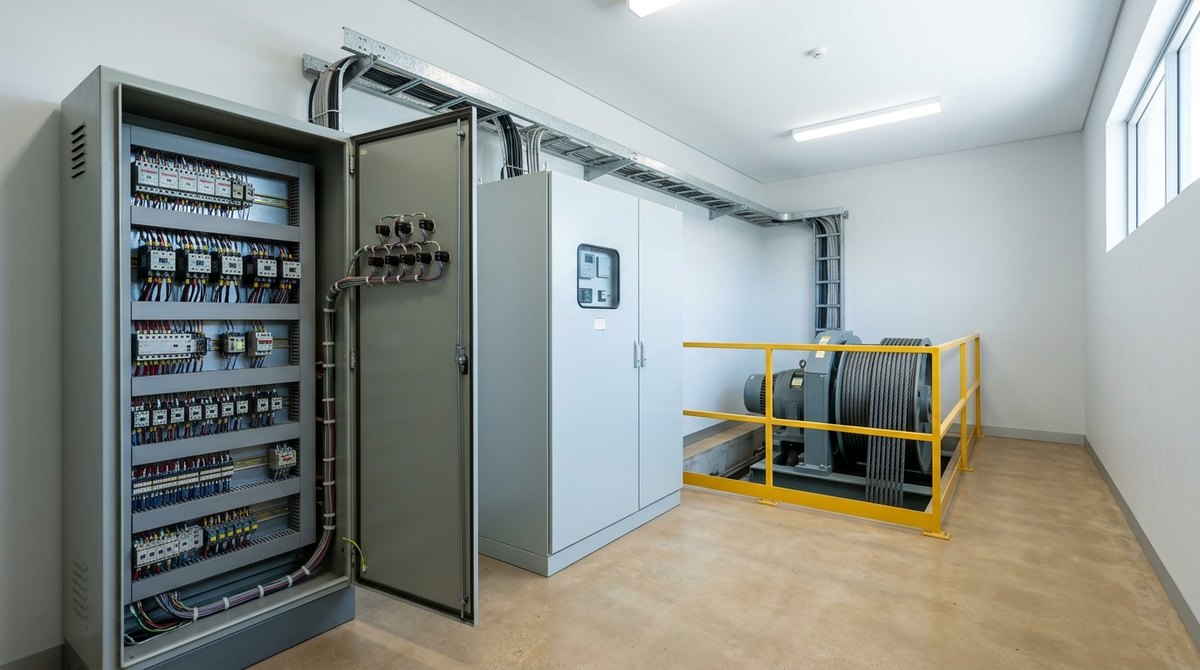
A lift rarely announces the end of its life by failing. It announces it by becoming unsupportable.
By the time an owner is weighing lift modernisation vs replacement, the equipment is usually still running. That is what makes it hard: nothing has broken, so nothing forces the spend.
Modernisation renews selected subsystems — commonly the controller, drive, door operator and fixtures — while retaining the shaft, structure and much of the mechanical installation. Replacement removes the whole unit and installs a new one. The choice usually turns less on how worn the equipment is than on what has become obsolete: once the control system can no longer be supported with parts, software and people, a lift that still runs every day has already reached the end of its useful life. Condition and obsolescence decide which path you are on. Downtime and capital cost decide when, and in what order.
What is the difference between modernisation and replacement?
A lift is not one asset but a stack of assets with very different lifespans, sharing a shaft. The civil elements age slowly, the electronics fast — not because they wear, but because the market moves past them. Between them sit the mechanical systems, the hardest-working being the doors and door operator, which cycle at every stop.
Modernisation exploits that asymmetry: renew what has aged, keep what hasn't, reuse the durable civil elements you already paid for. It is normally staged and partial, often unit by unit. Replacement is whole-of-unit: everything comes out and a new installation goes in.
| Modernisation | Replacement | |
|---|---|---|
| Scope | Selected subsystems — control, drive, doors, fixtures, others as assessed | The whole unit |
| Typically retained | Shaft, pit and overhead, often guide rails and car sling | Little beyond the shaft |
| Usual trigger | One subsystem obsolete or worn, the rest sound | Multiple systems at the end together, or a change in what the building needs |
| Outcome | Renewed where renewed; untouched components age on their original schedule | A uniform new baseline |
| Main risk | Interfaces between new and retained components; the residual life of what you didn't touch | Fewer interfaces, but a longer outage per unit and a larger commitment at once |
Why does obsolescence usually decide lift modernisation vs replacement?
Condition is what you can see. Obsolescence is what you can't — and it is the axis owners consistently underweight. It arrives in four ways, none visible on an inspection.
- Parts. Boards and assemblies go out of production. Supply shifts to reclaimed or refurbished stock. Lead times stretch from days to weeks.
- Software and tooling. The control system needs a proprietary tool, licence or laptop image no longer issued. Without it, nobody can diagnose the lift, however skilled.
- Knowledge. The technicians trained on that generation retire, and the system becomes unfamiliar to the people sent to fix it.
- Competition. When only one organisation can obtain the parts and the software, only one organisation can realistically tender for the maintenance. Technical obsolescence quietly becomes a commercial position.
An obsolete lift does not simply fail more often. It fails for longer — the part is chased rather than fitted — and costs more to hold, because nothing about the arrangement is contestable. Mechanically it may still be sound; commercially it is already a liability, and the timetable belongs to whoever holds the spares.
It surfaces as a drift in the numbers rather than a dramatic failure: falling lift availability is the symptom that starts most of these conversations.
How do you place your own building on the framework?
Condition and obsolescence together tell you what the intervention actually is.
| Parts and support still available | Support thinning or gone | |
|---|---|---|
| Condition sound | Maintain and monitor. Set the review date; don't spend. | The quiet liability. Modernise the control system on your schedule, before a failure sets it for you. |
| Condition worn | Targeted repair, or partial modernisation of the worn subsystem. | Replacement territory, particularly where machine, control and mechanical systems are all at the end together. |
What does the disruption actually cost in an occupied building?
Take a lift out of service and you have not merely inconvenienced people. You have reduced the building's capacity for the duration — and capacity does not degrade politely. A four-car group running on three is not three-quarters as good: near the capacity limit, queues lengthen sharply rather than proportionally, concentrating in the periods people notice — the morning arrival, the lunch peak. In graded office buildings, lift service sits among the criteria behind the grade, so a prolonged reduction is not only a tenant-experience question.
This cost is answerable in advance rather than discovered in week three. The group can be modelled with units out, and the answer sets the sequence — how many units at a time, in what order, in which months. Our traffic analysis article covers how group capacity is assessed; Traffic Studio is where that modelling gets done.
That analysis also disciplines the staging argument: staging is only relief if the remaining group can carry the load. In a two-lift building, one unit out is half the building's vertical transport, and the advantage evaporates.
How should capital cost enter the decision?
Last, and deliberately so. A cost comparison is only meaningful once the options are genuinely comparable, and at first pass they rarely are: modernisation and replacement buy different things. Compare them on what actually differs:
- What stays untouched, and when it comes due. A staged scope with a large deferred tail is a smaller number now and a scheduling problem later.
- Who can maintain the result — whether that is more than one organisation. This is where the obsolescence trap closes or opens.
- Energy performance. ISO 25745 provides an established method for measuring and classifying lift and escalator energy performance, so this can be compared on a stated basis rather than on a claim.
- The compliance position. AS 1735 is the Australian series for lifts, escalators and moving walks, and it addresses upgrades directly: what you renew is held to current standards, what you retain is held to the standard current when it was installed unless conformance cannot be shown, and the interface between the two must be risk-assessed. A separate part of the series deals with improving the safety of existing lifts. The standard has no legal force in its own right — it binds through statutory adoption or through your contract — so confirm the position for your building with the relevant authority and your consultant.
- Disruption, priced as capacity rather than inconvenience.
Capital is a portfolio constraint, not a per-lift one — and the ranking is often counter-intuitive. The building whose lifts are obsolete but sound may deserve capital ahead of the one visibly worn but still supportable. The supportable one can be repaired when it breaks. The obsolete one cannot.
What to do next
- Establish condition on evidence, per unit — not on impression or the contractor's summary.
- Establish obsolescence separately, in writing. Ask the incumbent: is the control system still supported? Are parts current production or reclaimed? What is the lead time on a controller board? What diagnostic tooling is required, and who can obtain it? Record the answers — they are the decision.
- Model the group with units out, before agreeing any scope or sequence.
- Sequence across the portfolio, ranking on obsolescence exposure rather than age.
- Decide what you want to own afterwards: how many organisations can maintain the result.
- Write the disruption plan before committing the scope, not after.
Short FAQ
Can you modernise one lift and leave the rest of the group? Commonly, yes. But where lifts are dispatched as a group, the group control is shared, so changing one unit's control system is seldom a purely local change. Establish that early.
Is replacement the safer choice? Not automatically. It is the bigger single commitment and the longer outage per unit, and may renew elements that had not aged. It is safer when the alternative is a hybrid held together across too many interfaces.
Decide it on obsolescence and capacity while the timetable is still yours.
Related reading
More from the MAPLE Ascent Insights series.
PCA lift grading: what does the grade actually measure?
What the PCA quality grade assesses in a building's lifts, why there are separate matrices for new and existing buildings, which peaks the waiting-time target covers, and the four questions the grade deliberately does not answer.
Read article →
Destination control vs conventional dispatch: what changes for tenants
How destination control differs from conventional collective control, what tenants actually notice about the change, where each approach wins, and what to ask for at design stage — for developers and building managers.
Read article →
What is a lift condition assessment, and when do you need one?
What a lift condition assessment examines, how subsystem ratings are derived and why methods differ, and how the findings become a defensible capital plan — for facilities managers and owners.
Read article →
How much energy do lifts and escalators use?
Lift energy consumption explained: running versus standby energy, what each modernisation technology step actually saves, and how ISO 25745 turns it into an energy class and a payback period.
Read article →
What does a lift maintenance contract actually cover?
What a lift maintenance contract actually covers — comprehensive versus basic scope, the exclusions that generate the extras, and the clauses that quietly decide cost and risk. A guide for building owners and asset managers.
Read article →
How to run a lift maintenance tender in Australia
Lift maintenance tenders in Australia — when to tender, what to prepare, how the process runs and the pitfalls to avoid, for building owners and managers.
Read article →
What is good lift availability? A benchmark guide
What lift availability means, what counts as good, and how to hold a contractor to it — a plain-language benchmark guide for building owners and asset managers.
Read article →
How many lifts does a building need?
Lift traffic analysis explained — waiting time, handling capacity and demand profiles, benchmarked against PCA, CIBSE Guide D and ISO 8100-32.
Read article →